RIR is reps in reserve: the number of clean reps you had left when you racked the bar. RPE is rating of perceived exertion, and in strength training it is the same scale counted down from 10. RPE 10 is nothing left. RPE 9 is one rep left. RPE 8 is two. Half points, such as RPE 8.5, mean you might have had one more and definitely not three.
The point is load that fits the day. A program that says 5 reps at 80% assumes your max is the same every session. A program that says 5 reps at RPE 8 asks for the weight that leaves two reps in the tank today. Strong day, the bar gets heavier. Flat day, you still do real work at the right effort.
Because every RPE maps to reps to failure, it also maps to a percentage of your max. 5 reps at RPE 8 is 7 reps to failure, which the standard chart puts at 81.1% of your 1RM. That is how a set you stopped short of failure still estimates your max.
How it works
- 1Finish the set. Before you think about the number on the bar, ask: how many more clean reps could I have done?
- 2That answer is your RIR. Subtract it from 10 for RPE: 2 in reserve is RPE 8.
- 3A clean rep means the same technique as the first rep. A rep that only goes up by changing the movement does not count as one left.
- 4Rate the set you did, not the set you planned. If RPE 8 was prescribed and it was RPE 9, log 9 and pick the next load from that.
- 5Calibrate now and then. Take a last set to a true rep max and compare it with what you predicted. Most lifters find they had more left than they thought.
The RPE chart: RPE, RIR and %1RM
Rows are effort, columns are reps completed, cells are the percentage of your one-rep max. Put your own set into the RPE calculator for an estimated 1RM and working weights.
| RPE | RIR | 1 | 2 | 3 | 4 | 5 | 6 | 7 | 8 | 9 | 10 | 11 | 12 |
|---|---|---|---|---|---|---|---|---|---|---|---|---|---|
| 10 | 0 | 100.0 | 95.5 | 92.2 | 89.2 | 86.3 | 83.7 | 81.1 | 78.6 | 76.2 | 73.9 | 70.7 | 68.0 |
| 9.5 | 0.5 | 97.8 | 93.9 | 90.7 | 87.8 | 85.0 | 82.4 | 79.9 | 77.4 | 75.1 | 72.3 | 69.4 | 66.7 |
| 9 | 1 | 95.5 | 92.2 | 89.2 | 86.3 | 83.7 | 81.1 | 78.6 | 76.2 | 73.9 | 70.7 | 68.0 | 65.3 |
| 8.5 | 1.5 | 93.9 | 90.7 | 87.8 | 85.0 | 82.4 | 79.9 | 77.4 | 75.1 | 72.3 | 69.4 | 66.7 | 64.0 |
| 8 | 2 | 92.2 | 89.2 | 86.3 | 83.7 | 81.1 | 78.6 | 76.2 | 73.9 | 70.7 | 68.0 | 65.3 | 62.6 |
| 7.5 | 2.5 | 90.7 | 87.8 | 85.0 | 82.4 | 79.9 | 77.4 | 75.1 | 72.3 | 69.4 | 66.7 | 64.0 | 61.3 |
| 7 | 3 | 89.2 | 86.3 | 83.7 | 81.1 | 78.6 | 76.2 | 73.9 | 70.7 | 68.0 | 65.3 | 62.6 | 59.9 |
| 6.5 | 3.5 | 87.8 | 85.0 | 82.4 | 79.9 | 77.4 | 75.1 | 72.3 | 69.4 | 66.7 | 64.0 | 61.3 | 58.6 |
| 6 | 4 | 86.3 | 83.7 | 81.1 | 78.6 | 76.2 | 73.9 | 70.7 | 68.0 | 65.3 | 62.6 | 59.9 | 57.4 |
Columns are reps completed. Cells are % of one-rep max.
In the app
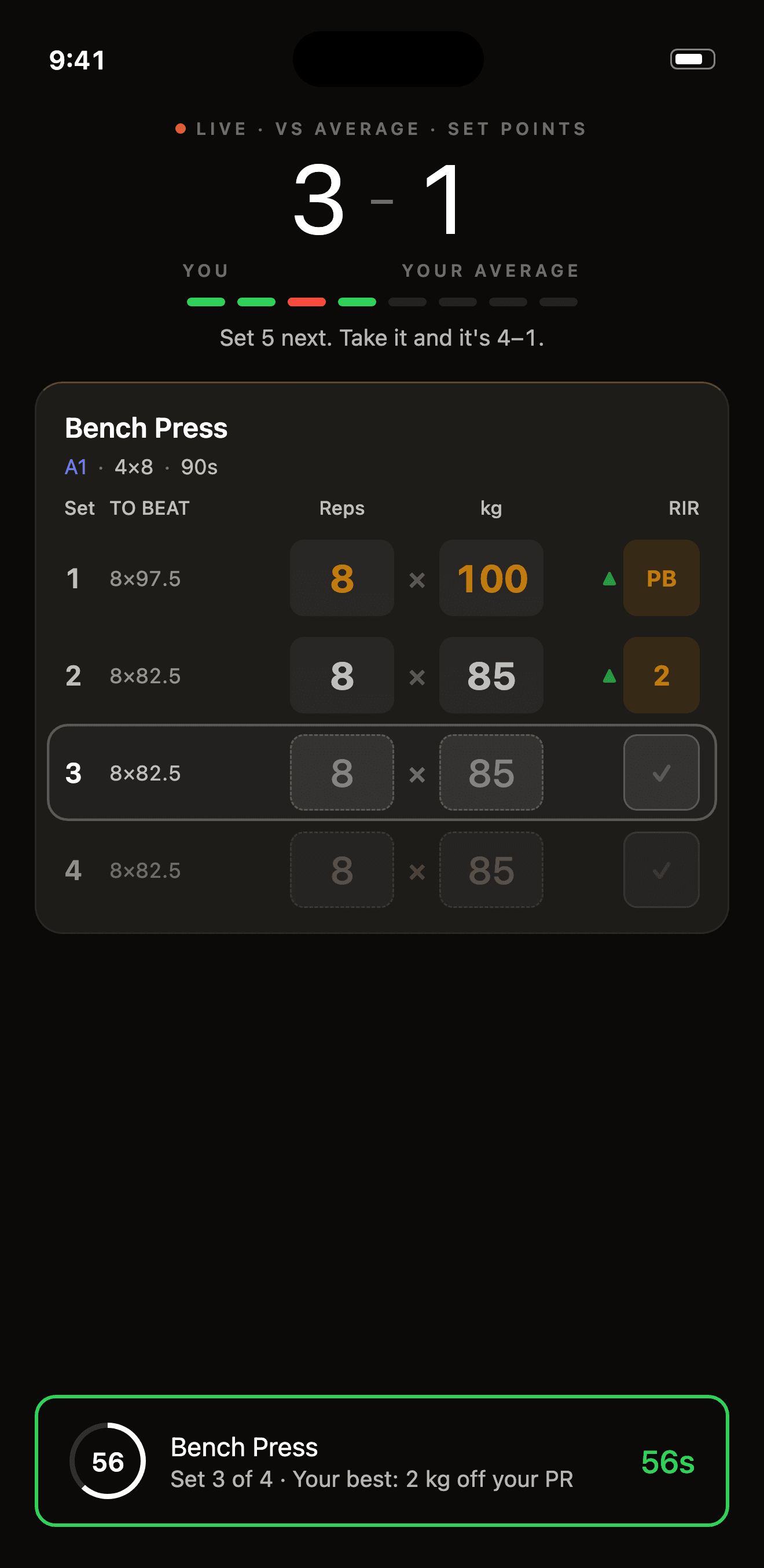
- —PRE SZN counts a working set at RIR 1–3 as a hard set. Warm-ups are excluded.
- —Every hard set is scored live against your own trailing four-week average for that exercise: the mean estimated 1RM of your hard sets. Beat your average, take the point. A record always pays.
- —The app reads the effort of every set from the load and reps against your own history, alongside what you report, so a rating that keeps drifting from the numbers shows up.
- —Programs that prescribe effort, such as RPE 8 daily singles or RIR targets that tighten week on week, print the target on every row.
Programs that run it
Academy: Upper / Lower
Four days, upper/lower. More volume, same simple rules.
8 weeks · 4 days/week
Hypertrophy Mesocycle
Volume landmarks. Add sets weekly, grow, deload.
6 weeks · 4 days/week
Powerbuilding — Upper / Lower / Full
Strength + size on 3 days. For lifters who know their numbers.
12 weeks · 3 days/week
PRE SZN Power Build
Six days a week. Daily heavy singles, 24 weeks to a test.
24 weeks · 6 days/week
Questions
What does RIR mean in training?
Reps in reserve: how many more clean reps you could have done when you ended the set. RIR 2 means two left in the tank.
Is RPE 8 the same as 2 RIR?
Yes. On the strength-training RPE scale, RPE equals 10 minus reps in reserve. RPE 8 is 2 RIR, RPE 9 is 1 RIR, RPE 10 is none left.
What percentage of 1RM is RPE 8?
It depends on the reps. A single at RPE 8 is 92.2% of max; 5 reps at RPE 8 is 81.1%; 8 reps at RPE 8 is 73.9%. The full chart is on this page and in the RPE calculator.
Why does PRE SZN count RIR 1–3 as a hard set?
Because that is the effort band where a set is real work and the rating is still reliable. A set with four or more reps left is closer to practice; a set at RIR 0 is a test. The line you race is built from the band in between.
Am I underrating my sets?
Probably by about a rep. A 2022 meta-analysis found lifters underpredict the reps they have left by roughly one on average, with better accuracy closer to failure. If in doubt, you had more.
Sources
- Zourdos MC et al. (2016). Novel resistance training-specific RPE scale measuring repetitions in reserve. J Strength Cond Res 30(1):267–275. doi:10.1519/JSC.0000000000001049
- Helms ER et al. (2016). Application of the repetitions in reserve-based RPE scale for resistance training. Strength Cond J 38(4):42–49. doi:10.1519/SSC.0000000000000218
- Halperin I et al. (2022). Accuracy in predicting repetitions to task failure in resistance exercise. Sports Med 52(2):377–390. doi:10.1007/s40279-021-01559-x