Why Your Training Program Doesn't Work (And Why That's The Point)
I've watched two athletes run the same program, eat the same food, sleep the same hours, and get completely different results. One puts on 5kg of lean mass. The other stalls at week three and starts dreading the gym.
This used to frustrate me.
Quade
When Quade Cooper started training six days per week, something clicked. He came back bigger and stronger than he'd ever been. This wasn't a small change. This was the period where he re-entered the Wallabies squad. He was outworking his teammates, visibly. The results were undeniable.
But I kept asking myself: why is THIS program working? What is it about this specific combination of volume, frequency and intensity that's producing these results for this specific athlete? And if it's working this well, should I put everyone on it?
I coach a world champion sprinter. If I put them on Quade's program, it would break them. Absolutely destroy them. They wouldn't make it through a single session without throwing up. I'm not exaggerating.
But that same sprinter does 60 minutes of high-intensity plyometrics, five days a week, and barely breaks a sweat. If Quade tried that plyo program? He'd break down within a fortnight.
Two elite athletes. Two completely different ends of the spectrum. Two programs that would be catastrophic if you swapped them. The "best program" doesn't exist. There is only the best program for a specific person at a specific time.
The question I couldn't answer
Earlier in my career, I was working with a squad and one of our best players, an international hopeful, started trending backwards in the gym. Everyone else was progressing. His numbers were going the other way.
Was it recovery? Volume? Frequency? Intensity? Too much of something? Too little of something else? I had twenty questions and no answers. I could see the problem but I couldn't isolate the cause. There were too many variables moving at once and I was tracking them in spreadsheets that were getting out of hand.
That experience stuck with me. Not because I failed that athlete, but because I realised the tools I had weren't good enough. I needed a way to actually untangle these variables. To test whether sleep was genuinely affecting this person's output, or whether it was volume, or some interaction between the two that I couldn't see.
That's where PRE SZN started. Not as an app. As a question I couldn't answer with the tools available to me.
What "personalised" actually means
Most apps say "personalised" and they mean you picked your goal from a dropdown. Hypertrophy. Strength. Fat loss. Done. Here's your cookie-cutter template.
PRE SZN means something completely different.
It means a Gaussian Process is learning your personal volume-response curve. Not the average response from a study of 20 university students. How YOUR body reacts to 12 sets per week versus 18 versus 24. Where your sweet spot actually sits.
New users start with population priors. Sensible starting points based on training age, goals and frequency, pulled from Schoenfeld's dose-response work, Israetel's volume landmarks, Gabbett's acute-to-chronic ratios. The foundational research that any decent S&C coach would reference.
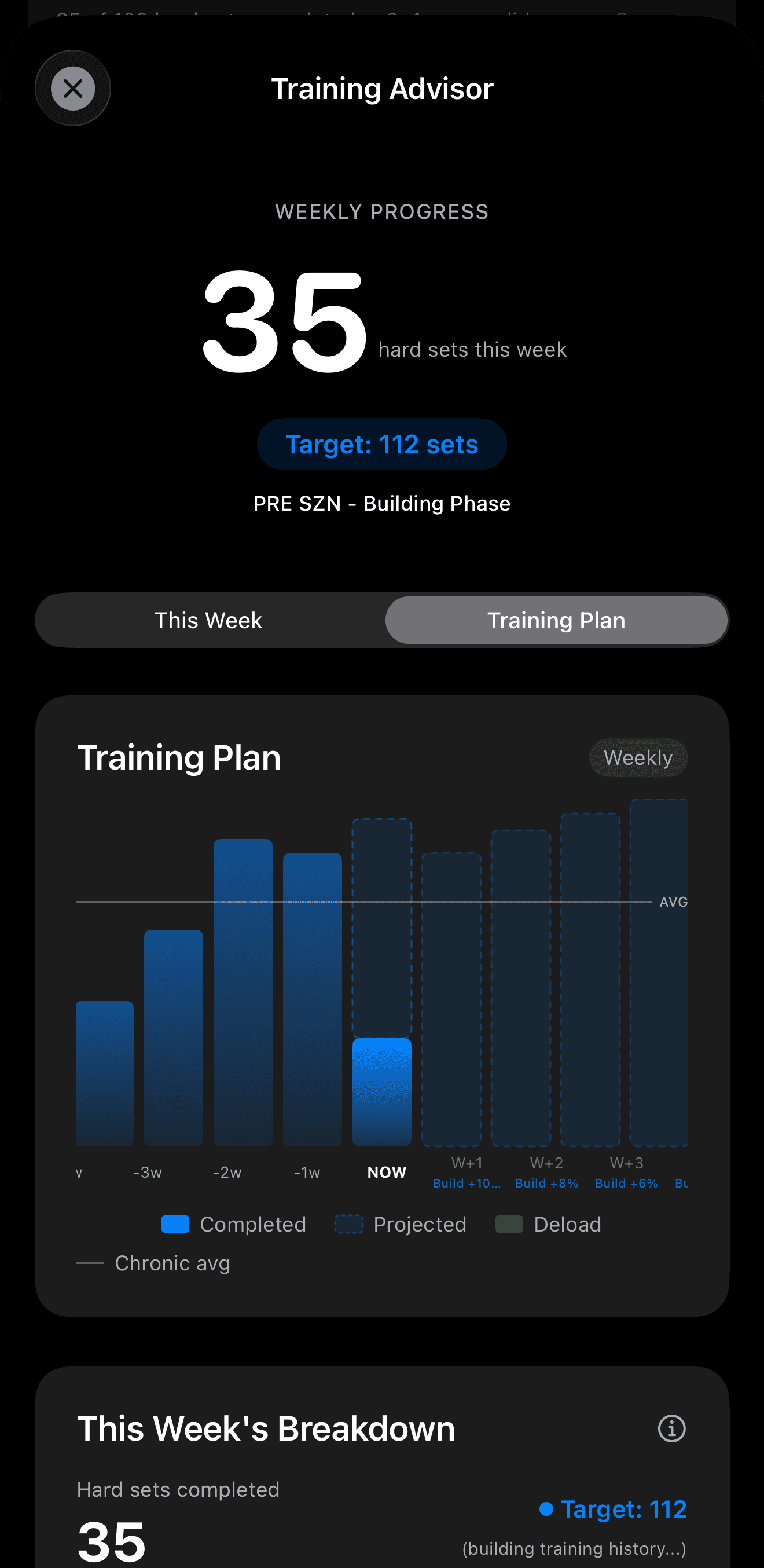
As your data accumulates, the model shifts. By week eight, it's mostly running on your data. By week twenty-four, it's almost entirely you. That transition from "what works for most people" to "what works for you" is what I used to do manually for every athlete I coached. It took months. PRE SZN does it systematically.
Your body writes the program
The textbook Banister model uses fixed time constants. 42 days for fitness, 7 days for fatigue. Every sport science student learns these numbers. Most apps use them.
They're averages. Averages are useless for individuals.
PRE SZN fits your personal time constants by running a grid search across your actual training history. For some athletes, the fitness constant is 35 days. For others, it's 56. That's not a small difference. That completely changes how you should structure a training block, when you should deload, and how aggressively you can push.
Your weekly volume target isn't fixed either. It's recalculated from your chronic training load, your current recovery state, and your individual capacity ceiling. There's a minimum to maintain what you've built and a minimum to keep progressing. Both numbers shift every week.
Finding what actually drives your results
This is what I wish I'd had with that player who was trending backwards.
Most training decisions are based on correlation. "I slept well and trained well, so sleep must matter." Maybe. Or maybe you slept well because it was a rest day, and the rest is what actually helped.
PRE SZN uses Granger causality testing to cut through this. It's a method from econometrics, published in 1969, that tests whether changes in one variable genuinely predict future changes in another. Does your sleep actually predict your performance two weeks later? Or is it noise? The system runs this across sleep, recovery, volume, frequency and intensity at multiple time lags, with Benjamini-Hochberg false discovery rate correction so statistical flukes don't end up driving your training.
I used to run this kind of analysis by hand for professional athletes. It took hours. PRE SZN runs it every time you sync.
The best program is the one you aren't adapted to
There's a lesson I learned early and keep relearning. A new stress elicits a new response. The program that stopped working didn't become bad. You adapted to it. Your body figured it out, responded to the stimulus, and now it needs something different.
This is why you'll never "finish" the gym.
The athletes who sustain long careers understand this. Training is a conversation with your body that never ends. Your volume tolerance changes as you age. Your recovery shifts with your sleep, your stress, your life. The program that worked six months ago might be exactly wrong for you today.
Static programs can't keep up with this. They work for a few weeks, sometimes longer, but eventually the gap between what the program assumes about you and what's actually true grows too wide. You stall. You get hurt. You lose motivation. You go searching for the next program hoping it'll be "the one."
PRE SZN doesn't give you "the one." It gives you a system that evolves. Gaussian Processes updating your optimal volume. Fatigue models refining your recovery constants. Causal inference finding new relationships in your data. Convergent fatigue detection watching multiple metrics so a deload isn't triggered by one bad sleep. It takes genuine multi-system fatigue before the system overrides your training.
The program you run in week one won't be the program you're running in week twelve. That's not a flaw. That's the point.
Why I built this
I've spent my career in elite sport. Masters degree in strength and conditioning. Published researcher. Conference speaker. I've worked with Olympians from multiple countries, world record holders, world champions, World Cup winners. Seven years alongside Quade Cooper building the systems that keep a professional rugby international competing at the highest level.
The tools I used with those athletes are the same tools running inside PRE SZN. Not a simplified version. Not a consumer-friendly approximation. The actual systems, on your phone.
I built it because the question that started all of this, why do some athletes respond differently, deserves a better answer than "everyone's different" and a shrug. The technology to answer it properly exists now. It shouldn't be locked behind professional sports contracts.
Every serious athlete who puts in the work deserves access to this. That's it. That's why it exists.
Written by Louis Dallimore
Related Posts
Ready to train with intelligence?
Get Early Access