What Actually Matters?
I used to sit in team meetings listening to coaches argue about what to work on. One coach thought kicking was the priority. Another was convinced it was defence. Someone else would bang on about dominant carries. Everyone had an opinion. Nobody had evidence.
I'd sit there thinking the same thing every time. Why are we debating this? Why don't we just look at the data and find out what actually predicts winning?
The spreadsheet
So I started pulling numbers. Rugby stats, GPS data, strength testing results, game outcomes. All into one spreadsheet. Missed tackles, metres carried, collision counts, sprint distances, max velocities, ruck speed. Everything I could get my hands on.
Then I started running correlations. Simple r values. Nothing fancy. Just asking the most basic question in sport science: which of these variables actually relate to the thing we care about? Winning.
Some of the results were obvious. Some weren't. Some of the things coaches spent hours debating turned out to have almost no statistical relationship with match outcomes. Some of the things nobody was talking about turned out to matter a lot.
It was crude. It was a spreadsheet with too many tabs and formulas that would break if you looked at them wrong. But it was the start of something.
The target problem
Around the same time, something else was bothering me. Targets.
In professional sport, you set training targets. Run this fast. Lift this heavy. Hit this many metres in a session. But when I'd ask why a target was set at a particular number, the answer was usually some version of "that's what we think is good" or "that's what we've always done."
What is good? Based on what? How does running 6,000 metres in training relate to what actually matters on game day? If we can't connect a training target to a game outcome, why are we chasing it?
This question consumed me. Not because I wanted to be difficult. Because I was responsible for preparing athletes to perform, and I wanted to know that what I was asking them to do actually mattered. That the targets I set were connected to something real, not just a number that felt right.
From correlations to causation
Simple correlations were a starting point but they weren't enough. Two things can correlate without one causing the other. Training volume and injuries correlate, but that doesn't mean volume causes injuries. It might mean the athletes doing the most volume are also the ones playing the most games, and the games are what's causing the injuries.
I needed better tools. I started reading outside of sport science. Econometrics. Time series analysis. Causal inference methods. Granger causality, which tests whether one variable genuinely predicts future changes in another beyond what you'd expect from its own history. Techniques that had been used in economics and epidemiology for decades but barely touched in sport.
The more I learned, the more I realised how much of what we do in sport is based on assumption dressed up as science. We collect enormous amounts of data and then make decisions based on gut feel and tradition. Not because people are lazy. Because the analytical tools to do it properly haven't been accessible to most practitioners.
Moneyball for sport. Then for individuals.
If you've seen Moneyball, you know the concept. Find the metrics that actually matter. Ignore the ones that don't. Make decisions based on evidence, not opinion.
I wanted that for the teams I worked with. Which physical qualities actually predict performance in this sport, for this team, in this competition? Not in general. Specifically. And then I wanted to set training targets that were connected to those qualities.
That system worked. It changed how I programmed, how I set targets, how I prioritised what athletes spent their limited training time on. Instead of chasing arbitrary numbers, every target was connected to something that mattered on the field.
But then I started asking the individual version of the same question.
If I can identify what physical qualities matter for a team, can I identify what training variables matter for a single athlete? Not which exercises are best in general. Which exercises, volumes, intensities, and frequencies produce the best results for THIS person. Based on THEIR data. Their history. Their individual response.
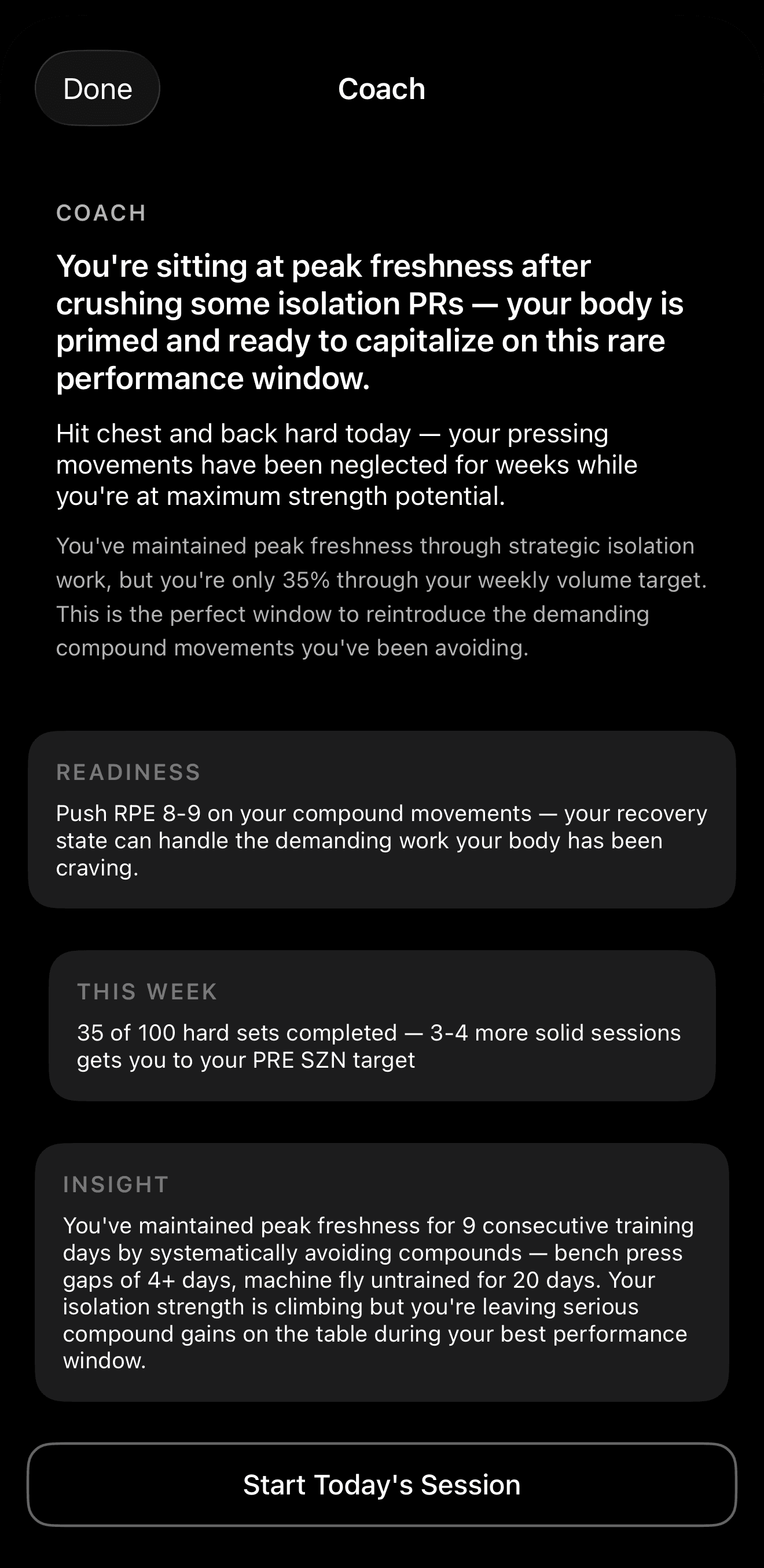
That's the question that built PRE SZN.
From the sideline to your phone
I spent years doing this manually. Spreadsheets. Statistical software. Hours of analysis for each athlete on my roster. It worked but it didn't scale. You can't run individual Granger causality tests for every athlete in a squad every week while also coaching sessions, writing programs, and managing the day-to-day chaos of a professional sports environment.
The app started as a way to automate what I was already doing. Gaussian Processes to learn individual volume-response curves. Busso fatigue modelling to fit personal recovery time constants instead of using textbook averages. Causal inference to test whether sleep, recovery, volume, and intensity actually predict performance for each individual user.
None of this is theoretical. These are the same analyses I ran for professional athletes, packaged into a system that runs automatically on your phone. The difference is you don't need a full-time sport scientist sitting in front of a laptop at midnight to get the answers.
What actually matters
The answer to the question is different for every person. That's the whole point. What matters for a 35-year-old rugby international is different from what matters for a 22-year-old sprinter is different from what matters for you.
The fitness industry sells certainty. "Do this program. Follow these macros. Train this way." It's comforting because it removes the need to think. But it's wrong. There is no universal answer. There is only your answer, found in your data, changing over time as you change.
That's what PRE SZN does. It asks the question I've been asking my entire career, "what actually matters for this individual," and it finds the answer using the same methods I used on the sideline with Olympic and professional athletes. Just faster. And for everyone.
The question that started as a frustration in a team meeting turned into a spreadsheet, then a statistical framework, then an ML pipeline, then an app. The question never changed. What actually matters? PRE SZN is how I answer it now.
Written by Louis Dallimore
Ready to train with intelligence?
Get Early Access