Who Are You Competing With?
I always train hard. I genuinely love lifting weights. But the second someone else is in the gym with me, something changes. My intensity goes up. The weight goes up. The effort goes to a place I can't get to on my own.
It's not even a choice. It's a deep, automatic need to compete and beat whoever is next to me. I think most serious athletes are wired this way. Training alone is fine. Training with someone you're trying to beat is different.
Moving countries broke my training
When I moved overseas to pursue professional sport, I lost the group of mates I'd been training with for years. Different countries, different time zones, different gyms. The training didn't stop but something was missing. That competitive edge. The accountability of knowing someone is watching your numbers. The unspoken challenge of loading the bar heavier than the person next to you.
I missed the team environment. The group of guys in the gym all challenging and pushing each other, the energy you get when everyone in the room is trying to outwork everyone else. You can't replicate that alone in a commercial gym at 6am in a country where you don't speak the language.
That's where the idea started. What if you could compete with your training partners even when you're not in the same room? Not in a gamified, badge-collecting, "you did 10,000 steps" way. In a real way. With real weights. On real exercises.
How it works
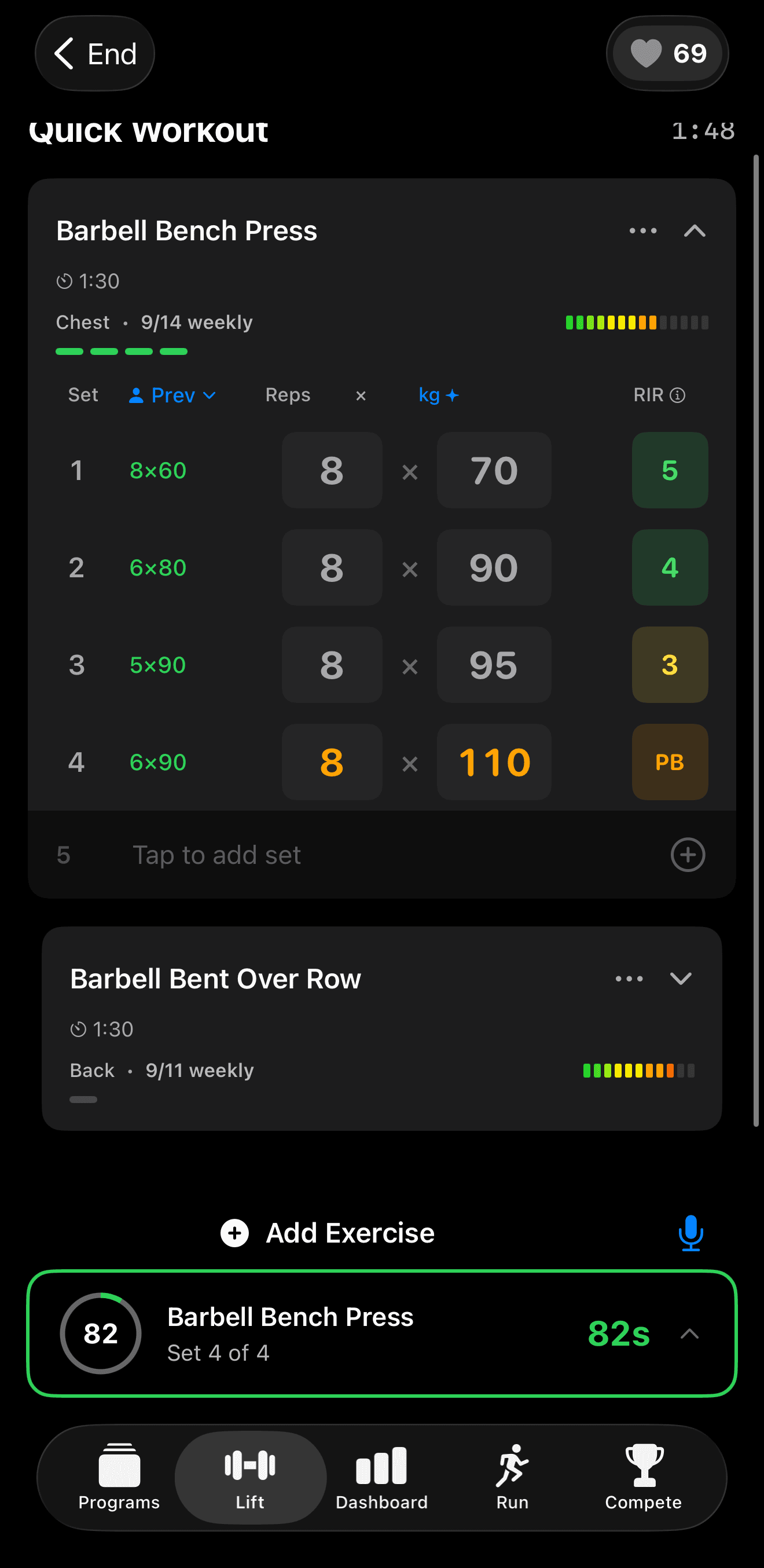
You challenge a mate. Pick an exercise, a metric, a timeframe. Seven days. While you're both logging your sessions during the week, you can see what they did. Not after the fact in some weekly summary. Right there in your workout, on the set you're about to do.
You're about to bench press. You see your mate hit 110 for 8 last session. You know you need to beat it. That changes how you approach the set. The weight goes up or the reps go up or both. Not because an app told you to. Because you refuse to lose.
At the end of the week, there's a battle report. PRs this week, sessions completed, total volume. Side by side. Winner takes it. The head-to-head record carries over. Week after week. It builds.
You can compete on consistency, total volume, exercise PRs, or percentage improvement. You pick the battleground. Some weeks it's about who moves the most weight. Some weeks it's about who shows up. Both matter.
Benchmarking against the best
Being involved in professional sport for as long as I have, I've always wanted to benchmark myself against the athletes I work with. Where do I sit? How far off am I? What does elite actually look like in numbers?
PRE SZN lets you compare your lifts against pro athletes. Quade Cooper's actual training data is in the system. You can see your bench press as a percentage of his. Your squat. Your deadlift. Not hypothetical numbers from a strength standards chart. Real data from a real professional athlete.
There's a running comparison too. You can race a ghost runner of your previous self, compare pace against a friend's run, or see your max speed as a percentage of an elite athlete's. There's even a sport equivalency mode that tells you what percentage of a professional AFL, soccer, or rugby game you just ran.
It sounds like a novelty. It's not. Knowing where you stand relative to genuine elite performance gives you a reference point that most people never get. It puts your own numbers in context.
The leaderboard nobody asked for (but everyone checks)
There's a leaderboard across your friends for every exercise. Ranked by estimated one-rep max. You can see where you sit on bench, squat, deadlift, whatever matters to you.
Nobody needs a leaderboard. Everyone checks the leaderboard. That's the point.
Why competition makes you better
There's nothing complicated about this. You train harder when someone is watching. You push more when something is on the line. The best training environments I've ever been part of, whether it was a national team gym or a club pre-season, had one thing in common. Everyone in the room was trying to be the best in the room.
PRE SZN doesn't manufacture that. It just removes the barrier of geography. Your training partner can be in another city, another country, another continent. You're still competing. You're still accountable. You still see their numbers before you start your set.
Some people train for health. Some people train for aesthetics. Some people train because they need to win. If you're the third type, this was built for you.
Written by Louis Dallimore
Related Posts
Ready to train with intelligence?
Download on the App Store